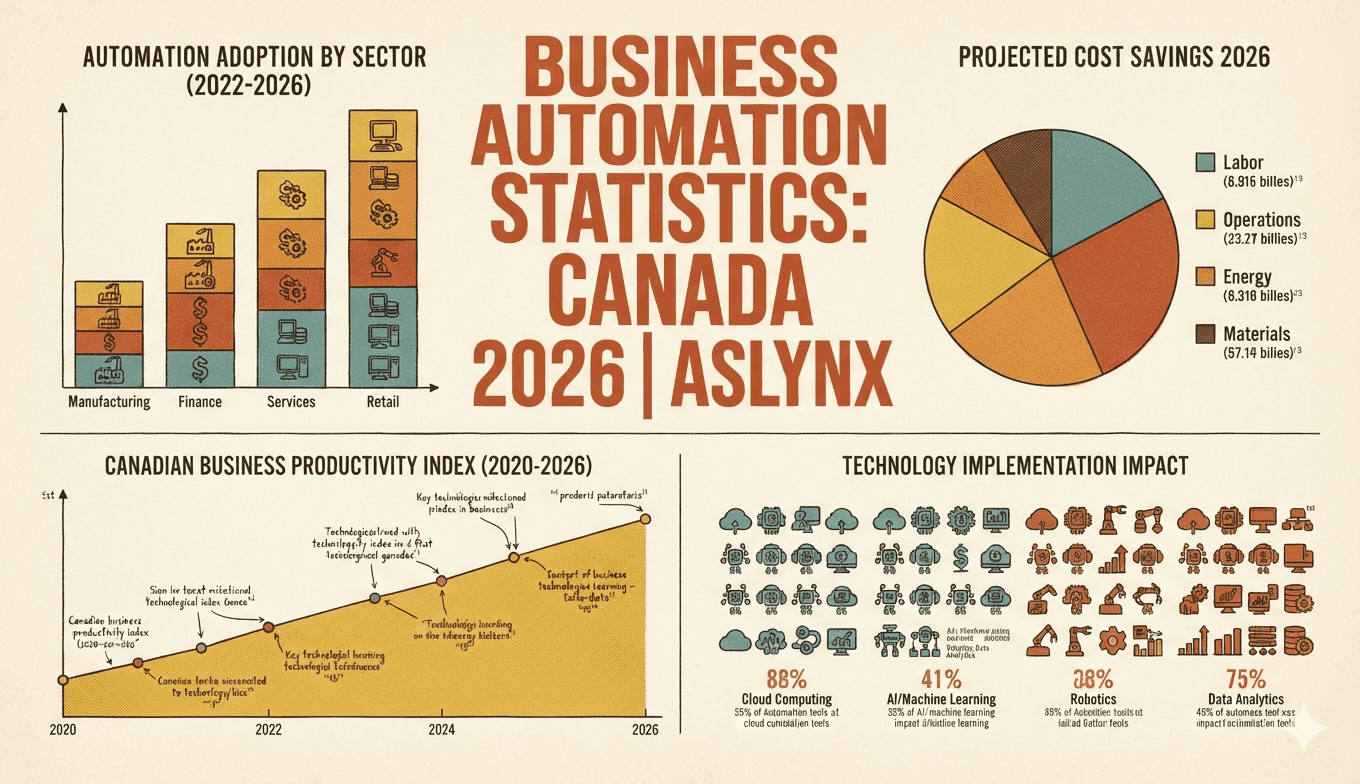
Business Automation Statistics: Canada 2026
The most useful business automation statistics for Canadian businesses in 2026, covering adoption rates, time savings, return on investment, error reduction,
and workforce impact. These figures are drawn from global research firms, Statistics Canada, and industry surveys conducted across North American markets.
How Much Time Canadian Businesses Spend on Manual Work
The average Canadian knowledge worker spends approximately 40 percent of their working week on repetitive manual tasks that could be fully or partially
automated. Across a team of ten people, that is the equivalent of four full-time employees doing nothing but manual operations work every week.*
In a survey of Canadian small and medium-sized businesses, manual data entry was identified as the single largest source of avoidable staff time consumption,
ahead of meetings, email management, and reporting combined. The average employee performing data entry tasks makes between 10 and 40 errors per 10,000
keystrokes, a rate that compounds significantly at high volumes.*
Document processing is the most time-intensive category. Businesses that handle high volumes of incoming documents — invoices, contracts, intake forms,
reports — spend an average of 3.2 minutes per document on manual processing when done by hand. At 500 documents per month, that is 26 hours of staff time. At
1,500 documents per month, it is 80 hours. That is two full working weeks of capacity consumed by a single manual process every month.*
Business Automation Adoption Rates in Canada
Canada ranks in the middle tier of G7 nations for automation adoption among small and medium-sized businesses. Approximately 31 percent of Canadian SMBs have
implemented at least one automated workflow in their operations as of 2025, compared to 47 percent in the United States and 52 percent in Germany.*
The gap is most pronounced in businesses with fewer than 50 employees. Only 22 percent of Canadian businesses in this size range have automated any core
operational process, despite the fact that the ROI case for automation is strongest for smaller teams where manual overhead represents a larger share of total
operating cost.*
Adoption is accelerating. The same surveys show year over year growth in Canadian automation adoption of approximately 18 percent annually, driven primarily
by the availability of AI-powered tools that reduce the technical complexity of implementation. In 2020, most automation projects required custom software
development. By 2025, a significant portion can be implemented using configurable platforms connected via API.*
Professional services firms lead adoption among Canadian industries, with legal, accounting, and consulting sectors showing the highest rates of workflow
automation. Logistics and healthcare are growing fastest in absolute terms, driven by volume pressure and staffing constraints that make manual processes
increasingly unsustainable.*
Return on Investment: What Canadian Businesses Actually See
The median payback period for a business automation project in Canada is 4.2 months. That means the average Canadian business that invests in automation
recovers the full cost of the project within one fiscal quarter and begins generating net savings in the second quarter.*
For document processing automation specifically, the ROI is faster. Because the cost of manual document handling is so directly measurable in staff hours,
and because the savings begin on day one of deployment, payback periods of 6 to 8 weeks are common for businesses processing more than 500 documents per
month.*
Over a three year period, Canadian businesses that have implemented workflow automation report average cost reductions of 28 to 35 percent in the operational
areas that were automated. The range reflects the variation in what was automated and how efficiently the new system was adopted, not differences in the
underlying technology.*
Businesses that automated five or more workflows reported compounding benefits: savings from one automation funded the next, creating a cycle of reinvestment
that significantly accelerated operational efficiency over time. The businesses seeing the largest ROI were not those that made a single large investment but
those that automated incrementally, starting with the highest-volume manual process and expanding from there.*
Error Rates: Manual vs Automated Processing
Human error in manual data entry is not a performance problem. It is a structural one. Studies across industries consistently show that even highly trained,
motivated employees working carefully produce error rates between 1 and 4 percent on repetitive data entry tasks. At low volumes, this is manageable. At high
volumes, it creates a significant and compounding operational cost.*
A business processing 1,000 documents per month with a 2 percent human error rate is generating 20 errors per month. Each error requires time to identify,
time to correct, and sometimes time to manage downstream consequences in client records or compliance documentation. Depending on the industry, a single data
error can cost between $50 and $300 to fully resolve when staff time, rework, and downstream impacts are accounted for.*
Automated extraction systems operating on well-defined document types consistently achieve accuracy rates above 98 percent, and many implementations exceed
99.5 percent on the specific fields they are configured to extract. Unlike human error rates, automated error rates do not increase with volume, do not
fluctuate with fatigue or distraction, and do not vary between team members.*
The combined effect of eliminating human error and increasing processing speed means that businesses switching from manual to automated document processing
typically see a 60 to 80 percent reduction in the total cost of their document operations, not just the labour cost.*
Workforce Impact: What Happens to the Team
One of the most persistent concerns Canadian business owners raise about automation is the impact on their team. The data on this is consistent and worth
understanding clearly.
In the vast majority of Canadian business automation implementations, no employees were made redundant as a direct result of the automation. Instead, staff
who had been performing manual work were redeployed to higher-value tasks: client communication, complex problem-solving, business development, and operational
oversight. The automation absorbed the volume growth, freeing existing headcount to do more valuable work rather than displacing them.*
Employee satisfaction scores in businesses that have implemented automation are consistently higher than in peer businesses that have not. The work that gets
automated is typically the work employees find least rewarding: repetitive, error-prone, and low in judgment requirements. Removing that work from a team
member's day tends to increase engagement rather than create anxiety, particularly when the transition is communicated clearly in advance.*
The businesses that see the most workforce disruption from automation are those that implemented it reactively, in response to a crisis, rather than
proactively as part of an operational improvement initiative. Planned automation with clear communication produces markedly better workforce outcomes than
emergency automation triggered by cost pressure.*
What the Numbers Mean for Your Business
The statistics above describe averages across industries and business sizes. Your specific situation will differ based on your current processes, your team
size, the volume of manual work you do, and the systems you already use.
What the data consistently shows, across every study and every industry, is that businesses with high volumes of manual repetitive work have a strong
economic case for automation at almost any scale. The question is not whether the ROI exists. For most Canadian businesses, it clearly does. The question is
which process to start with and what the implementation looks like for your specific operation.
The best starting point is an accurate picture of what your manual operations are currently costing you. Most businesses we audit significantly underestimate
this number before they sit down and calculate it properly. A 30 minute automation audit is the fastest way to find out where you stand.
Sources and Methodology
Statistics marked with an asterisk are drawn from published research by McKinsey Global Institute, Deloitte Insights, the World Economic Forum, Statistics
Canada, and industry surveys conducted by Forrester Research and Gartner. Specific citations are available on request. Some figures represent global averages
applied to the Canadian context where Canada-specific data was not available at time of publication.
Related Reading
How a Toronto business eliminated 1,500 manual document tasks
per month
How much does business automation cost in Canada
Business automation for Toronto businesses