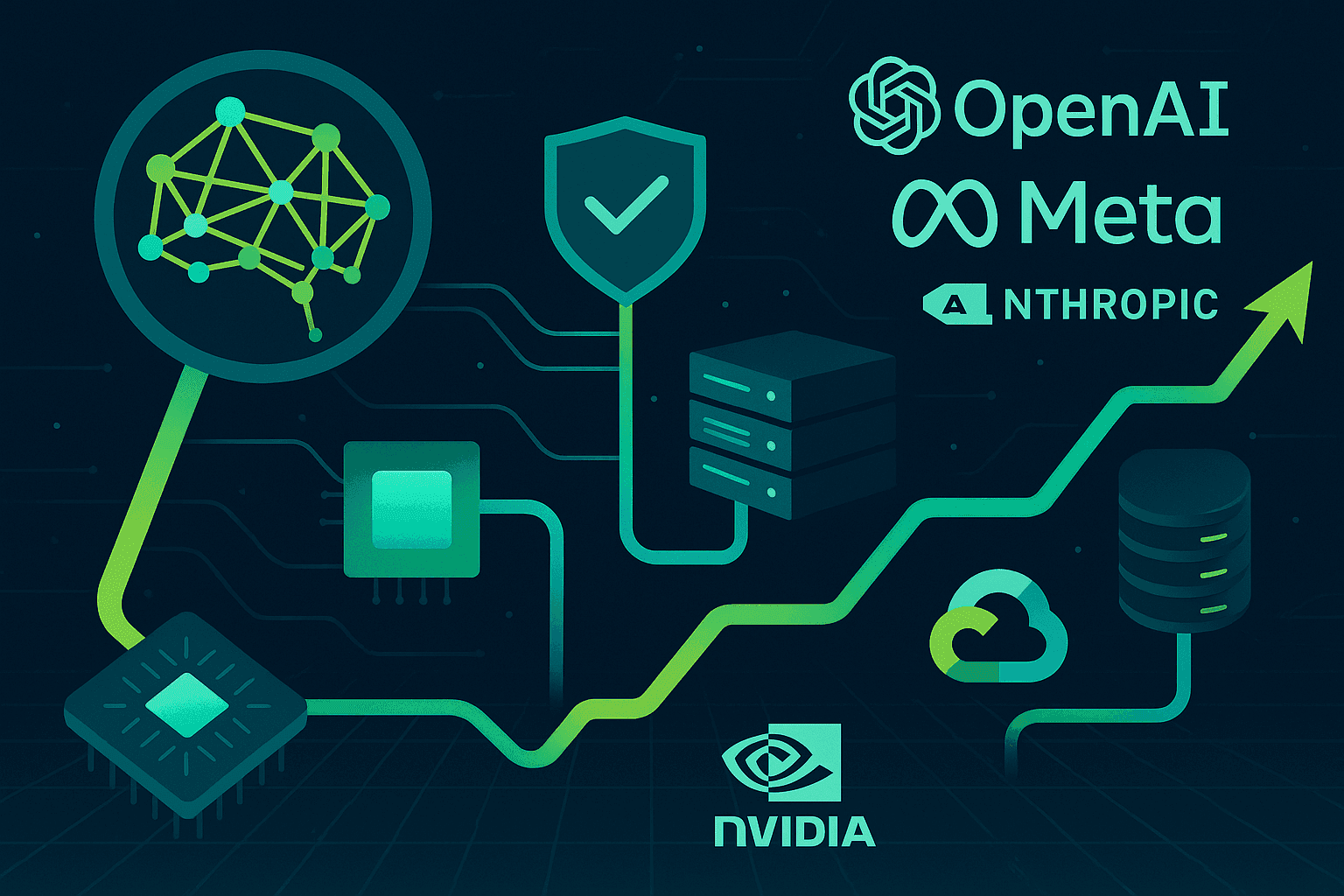
Entering a fast-growing market. Businesses employ many API models for complicated reasoning. Frontier for complicated thinking, compact for speed, open-source for customization, and on-device for safer trading and fighting foes. Growing context windows affect how agents perceive and act across organizational systems. Specialized vector retrieval starts. Data export to model silos is being reversed by AI deployment closer to data. Favoring Platforms with Better Model Orchestration Governance and Observability but Lower Stack Inference Cost
Two things effect timing. GPU supply has improved and roadmaps have cleared, lowering unit costs. This supports last year's hazardous architecture.
Boards desire productivity increases, regulators are completing standards, and CFOs are evaluating small line items. EU AI Act stages and U.S. safety and transparency rules require suppliers to provide eval tools, audit hooks, data provenance, performance, and price concessions. Mathematical and managerial tools altered clouds. As operational quality rises and cost per useable product declines, generated AI is reaching a similar tipping point.
As multimodal and reasoning releases prioritize latency and cost over benchmark performance, utility matches hype. This new OpenAI GPT-4o center stage price plan offers multimodal responsiveness in under a second. Chain-of-thought and tool use are valued over parameter counts in the logic-centric o-series. When latency and price drop, a sales enablement assistant that can scan a 200-page RFP and anchor its responses in CRM, pricing regulations, etc. becomes a daily tool Scanning PDFs, photos, and forms with multimodal intake has reduced preparation time for many US and UK professional services firms. They create high-quality ideas and actions from chaotic inputs.
Google Gemini 1.5 stressed context length and orchestration. Many teams' pre-chunking gymnastics is eliminated by million-token windows. Important because retrieval-augmented generation can be selectively added or defaulted. Pro thinks big while Flash does low-cost, high-throughput work, reflecting a growing division of labor in firms: one model plans, while another executes. Workspace integration affects generative AI model performance. Securely working on papers, meetings, and spreadsheets with enterprise-grade access restrictions makes models active users. So, shadow AI decreases. IT, compliance, and general compliance rise.
At corporate job competitive pricing, Anadropic's Claude 3.5 Sonnet prioritized reliability, tool utilization, and coding speed. Governing abilities and safety research with design techniques help regulated organizations that favor low-level creativity with predictability over high-level innovation. Model behavior drift is a commercial and technical risk when an off-policy reaction might damage reputation, compliance, or worse. More fidelity in JSON mode reduces integration friction with back office systems, and Claude emphasizes frequent tool invocation. Scaling dozens of operations saves months of deployment time, though minor.
Meta's Llama 3 and Mistral's Large models altered unit economics. The frontier and commercially viable base model training for domain workloads on commodity accelerators were your only options last year. For the correct use cases, mature MLOps around LoRA adapters, retrieval, and lightweight distilling can accomplish quality requirements at a fraction of closed model cost. Public APIs cannot deliver enterprise-grade data residency and compliance like Cohere. Architecture second-order effects make multicloud and multi-model routing useful; policy engines choose the appropriate model for workload, jurisdiction, and budget.
On-device and hybrid intelligence may be discounted soon. Apple's private cloud computation and on-device model execution impacted security and corporate edge privacy-performance relationships. Local summarization, redaction, and classification should touch the cloud sparingly and anonymously to reduce risk and cost. Developers may now assess and strip PII on-device, escalate difficult ones to the cloud, and follow organized compliance incidents. Increasing data center capacity won't reduce network latency in retail handhelds, field service tablets, and automotive entertainment.
Silicon behind the model layer affects all CFO worksheets. For massive decoder workloads, NVIDIA's next-gen architecture boosted connectivity, memory, and transformer engines to lower the training-inference cost feedback loop. Critically, Inference microservices, Triton, CUDA libraries, enterprise support bundles, and hardware enable operationalizing your models easy without constructing a dozen new elements. AMD, an underdog, improved price-performance with accelerators. Many teams consider software moat. A kernel rip-and-replace takes time. Third, procurement can better plan capacity by dividing processing power/model class by accelerator tier instead of total inference.
Data platforms have surprising power since retrieval quality and governance affect downstream model performance. Databricks' DBRX and Lakehouse AI stack, Snowflake's Arctic and Cortex, and Polaris open catalogs introduce managed data models. AI, data, and security teams collaborate to solve old problems. Vector search has storage, policy enforcement, and dynamic data lineage like google.com. This pattern applies to scaled AWS Bedrock and Azure model endpoints. Legal and compliance can relax as product teams ship with procurement-friendly controls, private networking, and enterprise-grade observability.
Competition prioritizes system quality and task cost over quantity. Closed models have the hardest reasoning and best multimodality. Open, compact models are replacing templated, high-volume procedures. Price supremacy, lateness. It assists vendors with orchestration layers and policy routers that route class requests without user training or application code changes. As inference scales, chipmakers and cloud providers profit from application-layer businesses competing on proprietary data, vertical workflows, or distribution agreements rather than raw model access.
Soon, model breadth, governance depth, and predictable unit economics will win. Cloud platforms with model marketplaces and private networking facilitate procurement. We need data cloud vendors with better vector, lineage, and access restrictions. Every minute saved on brittle glue code decreases TCO, therefore enterprise integrations pick model labs with tool use standards, JSON-native exports, and well-documented function calling (with explicit contract language). Frontier models are common in one-trick wraps. Without data or domain moats, these lag. Normal procurement lowers gross margins.
Planning, phoning, and writing to corporate systems will use agentic systems instead of chat interfaces. Zero-trust enterprise systems last 6–12 months. Teams will employ more evaluative harnesses, red-teaming, and offline simulation environments if they focus on bad behavior rather than words. With infinite context windows for most use cases, retrieval will be a first-class query planning problem employing symbolic filters and semantic vectors. Improved accelerators and quantization should lower prices for high-margin use cases.
Devices and cloud services will merge. Device models will scan for safety, pre-process sensitive data, and personalize preferences; cloud models will reason across users, compute intensively, and integrate source systems. Legal scrutiny will include data provenance and modeling. Training providers may have to watermark and share data. 1. Organizations may have confusing content and data policies. Models will produce lineage, retention, and access policies.
It's easy to ignore deployment-critical operations in excitement. Teams need business metrics-based offline and online evaluation methods, not only BLEU or generic victory rates. Evaluation is not a checklist. GitHub Copilot boosted productivity. Repeatable wins came from tight job scopes and guardrails. Many fields benefit. Use fast repositories, test sets, and canary releases to avoid quiet model version or routing policy regressions. Ensure API service security with manual human approvals and traceability.
Leaders have two betting priorities. Portfolio approach. After standardizing frontier, mid-tier, and compact models, build policy-based routing with cost, latency, and compliance limitations.
Upstream governance can benefit from paradigm shift. Integrating data catalogs, feature stores, and vector indices into one permissioning plane saves months of retrofitting. Decreases data leakage. Finance teams should consider job cost, while technical teams should test workflows on privacy- or reliability-sensitive devices. That lens helps vendors explain price and performance and create trust faster.
Company and partner prospects exist without thin wrappers. Vertical specialists with specialized ontologies, private datasets, and tight integration into core systems of record will profit from generic model commoditization. Prioritizing agentic system assessment, safety, and observability gaps will reveal silent failures, hazardous tool calls, and low retrieval quality. Red flags include one model provider, sophisticated data processing, and automated manual activities. Not just a chatbot feature, AI will benefit those who see it as an integrated managed system with proven commercial benefits at a reasonable unit cost.