What exactly is an agentic AI system and how is it different from single-shot chatbots? Agentic systems implement plans, activate tools, and self-improve towards goals, often orchestrating behavior across multiple steps. Being action-oriented, they need a strong identity, and with that, permissioning and auditability can get complex. According to industry analysts, enterprise AI software has the potential to reach a whopping $200 billion by 2026. It is expected that this industry will grow at a CAGR of 30 to 35%. This is why security and cost controls are so important today. When building agents, you should do so like you would for any production service according to best practice guidance inspired by the NIST AI Risk Management Framework and OWASP ASVS. Authenticate every call, authorize every action, and log every decision to trace it later.
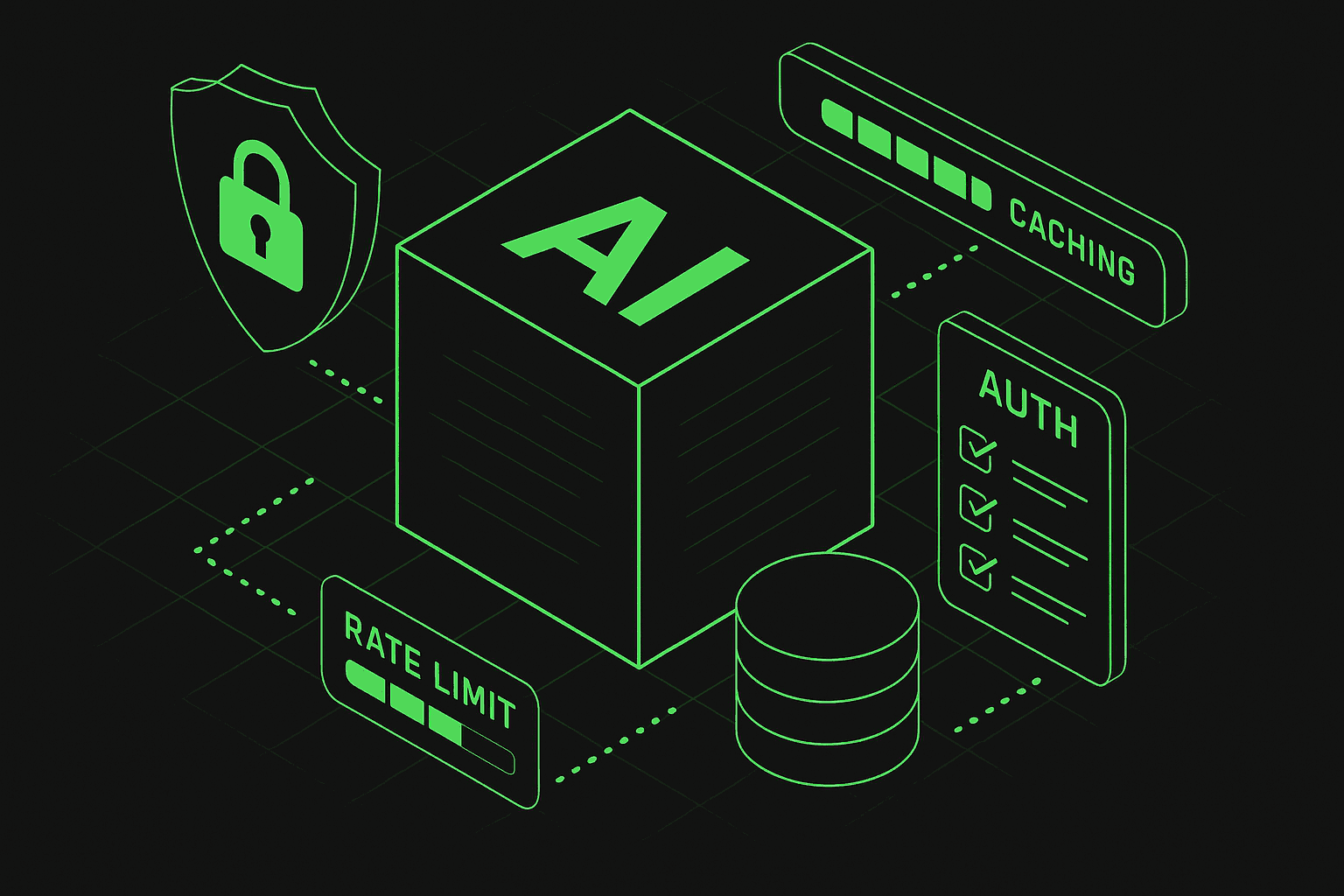
What does the high-level architecture look like? Imagine a situation in which a client attempts to reach an API Gateway enforcing OAuth2/OIDC, then a Policy Engine that evaluates access to permissions (RBAC or ABAC), then an Agent Orchestrator (LangChain or similar) that picks from many tools, consults a LLM, and emits one or more actions. From lexical and semantic inference caching using a Redis layer to object storage or Postgres storage of session context, streaming of traces to your observability stack using OpenTelemetry pipelines, and guardrails ensuring PII redaction or safe tool calls. By prioritizing caching, compressing prompts and using tool timeouts, we aim to hit p95 latency for frequent queries under 800 ms. When a cache is hit between 35-60% of the time, repeated requests will use a third (or more) less tokens and egress.
How do you quickly create a structure of a project which can be maintained easily? Utilize Cookiecutter to build a FastAPI + LangChain template. We will initialize the repository with the following typed modules: api (routers, auth), core (config, logging), agents (chains, tools, policies), cache (redis, embeddings), and monitoring (otel, metrics). Using Cookiecutter tool makes it easy to produce repos that follow the same pattern, impose linters (black, ruff) and add CI (Github Actions). This is what the Python community recommends as best practice and speeds up onboarding by 20-30% in the first month. Store your secrets in a cloud secret manager and inject them at runtime; never commit API keys. This is built on RAG system fundamentals to create a strong (and secure) foundation for multi-tool agents that can also retrieve proprietary context.
How do you implement authentication correctly? Use OIDC and OAuth 2.1 with PKCE authorization protocol for public clients. Provide short-lived access tokens (10-15 minutes) and refresh tokens (7-30 days) using a managed provider like Auth0, Azure AD, and Google Identity. If your application processes sensitive data and requires advanced controls, implement the following:
- Validate JWTs server-side with rotating keys (JWKS).
- Enforce issuer and audience checks on low-risk environments.
- Bind sessions to device fingerprints in high-risk environments. For communication between services, it is recommended to utilize client credentials along with mTLS or workload identity. Examples of workload identity include GCP Workload Identity, AWS IAM Roles, and Azure Managed Identity. You can expect a 5 ms and 10 ms overhead at the gateway. As we covered in our previous article on advanced prompting techniques, always keep human and system prompts separate and annotate logs with the user’s identity for audits.
What about authorization beyond simple roles? Consider creating a layered RBAC implementation, complete with org, project, and dataset scoping for resources. If you need contextual policies – e.g., time-of-day or data sensitivity – ABAC may make sense. A policy engine (like Oso or Casbin) allows you to say things like “analysts can run read-only tools on dataset X; only admins can execute write tools.” Make sure your policies have PIPEDA compliance for personal data in Canada, and follow least-privilege guidance for SOC 2 and ISO 27001. Ensure you maintain a decision log (including reason, policy version, request context). This traceability is vital when reviewing incidents. The authorization of agentic systems must control access to relevant tools—not just data—to be effective. This distinguishes agentic from traditional search methods (keyword-based search systems). This is due to the fact that a tool call can invoke an outside effect (file edit, CRM update, API transaction…).
How should you design the agent itself? To prevent runaway costs, use a deliberation loop with 2-3 reflections. Limit tool calls to 3–5 per request. Emplace a per-call timeout (e.g., 1–3 seconds) to maintain p95 latency <800 ms. Employ structured tool schemas with JSON Schema validation and introduce allowlists for hosts and methods in HTTP tools. For large language models (LLMs), OpenAI's GPT-4 Turbo or GPT-4o and Anthropic's Claude 3.5 Sonnet are the strong choices for function-calling reliability. Longer paraphrase (27 words)
Providing language models the same capabilities as software (e.g. Github); a version registry, which uses semantic diffs for comparison, gives insight on the progression of prompts. As per the practitioners, prompt versioning lowers the chances of regression incidents between releases by 25–40% when used in conjunction with offline evals.
How Do You Implement Inference Caching? And Where Does it Fit? There are three caches. The first one is at request level which is a lexical cache keyed off the normalized prompt hash. The second one is a semantic cache which uses embeddings along with cosine similarity thresholds of 0.90-0.95. The third type of cache is a tool aware partial cache like cache weather lookups for 5 minutes, exchange rates for 60 seconds, etc.
Buffers work quite well for layer 1 and layer 3; a vector index (Redis with vector support, postgreSQL pgvector, or a dedicated store) handles layer 2. If you warm your popular prompts at startup and pre-compute embeddings, you can achieve a 35-60% hit rate for high-traffic apps, reducing token spend by 30-45% and shaving off 120-250 ms of average latency. It is particularly effective in chatbots, customer service, code assistants, where intents repeat. Like the effective optimization of semantic search with vector databases, tune your similarity threshold to make sure you get maximum hit rate without stale answers.
How do you ensure safety and alignment in production? Use layers to restrict access and performance by implementing input filters to flag personal identified information (PII) and jailbreaks and output filters to detect data loss or other blocking content along with a policy gate to verify compliance before a tool can perform any action. Implement moderate filtering for the text and a stricter policy for tool calls, especially write/tx tools. Set maximum usage limits for every user and organization to handle spikes. Log and sample 1–5% of traces to a system such as LangSmith, Honeycomb, or OpenTelemetry backends, correlating user ID, policy decisions, LLM model and version, and cache outcomes (hit/miss). Enterprise teams these days are using robust retries and circuit breakers to stay within their SLOs and nailing industry benchmarks aiming for 99.9% uptime with an error budget of 43 minutes a month.
How do you evaluate quality and measure ROI? Develop a small methodical evaluation set (50-200 cases) spanning your top intents and edge cases. Ensure that actions are taking place on a routine basis to enable any remediation which might be required. According to reports in Q3 2025 from teams, enhanced implementation of tool limitations and prompt safeguards has resulted in containment benefits of around 20-35%. Allocate dollars to every piece: the LLM tokens, embedding calls, tool invocation, and egress cost. A good goal is less than $0.01 per common prompt while in development and less than $0.05 at p95 for complex tasks. You can adjust this according to your domain and desired response length. Find out more about ROI calculation methods and measuring AI project success to justify scaling your deployment.
What does a minimal implementation plan look like? During the first week, we will install Cookiecutter. Then we will wire FastAPI. Next we will add OIDC. Finally we will stub RBAC with three roles and user classes. In week 2, we plan to integrate langchain 0.2.x, define 3-5 tools, add function calling with json schema, and limit loops to 3. Redis's semantic cache (pgvector; threshold 0.92) and a lexical cache with a TTL of 24 hours will be added week 3. In week 3 we will also add cache tagging for invalidation. For week 4, we focused on observability, evaluation harness and rollout guardrails. By week 5, you should containerize, perform load tests (500-1000 RPS burst + 50-150 ms cache service p95) and staged rollout behind feature flags. The technique of gradual deployments for [INTERNAL_LINK: enterprise AI adoption strategies | implementing AI at scale] minimizes risk and provides quick feedback
Which providers and tools should you choose? As for the models, physician-openAI GPT-4 turbo/gpt-4o is for strong tool use, Anthropic Claude 3.5 is for reasoning and guardrails, google vertex ai is for integrated governance. For identifying: If you want speed then Auth0, enterprise SSO then Azure AD, and for G Suite shops it’s Google Identity. Either use Redis 7+ with vector indexing or PostgreSQL 15+ with pgvector 0.5+. For orchestration: either LangChain 0.2.x or guidance with function-calling; both support structured tool functionality. Kubernetes with HPA/VPA, or serverless APIs for spiky workloads Use NIST AI RMF and the respective sector’s compliance like HIPAA, PCI DSS to avoid the hassle of audits. As mentioned in the guidelines for choosing AI partner, ensure you do have an SLA with your vendor and include uptime, latency and data retention clauses.
How do you keep costs predictable? Establish limits for individuals and groups on permissions and validation resources. Enterprises can use cheap embeddings (i.e., small but accurate enough models) for semantic caching. Also, think about quantized local embeddings for privacy. To enable prompt compression, we strip the stopwords, dedupe the context, and for long history use retrieval not replay full transcripts. Collaborate with PaaS: monitor these metrics, identify non-sequential request patterns, and detect anomalies. Teams that undertake weekly reviews tend to achieve **15-25%** monthly cost reduction without compromising quality after tuning caching.
A quick operational checklist helps avoid surprises. To enhance security, rotate JWKS and enforce TLS 1.2+. Also pin outbound domains for tools and run SAST/DAST in CI. Circuit breakers around tools, exponential backoff with jitter, and bulkheads to isolate model calls. For observability, trace each span (auth, cache, model, tool) and log prompt ids (not raw prompts for sensitive) and aggressively sample for failures. Classify stored context as PII, encrypt at rest using AES-256, set region locks as appropriate. Governance: version prompts, tools, and policies; tie deployments to feature flags and maintain a rollback plan. This implementation followed the best practices for enterprise AI deployment, which have long been used in cloud microservices, and only now applied to agents.
Making use of FAQs can shorten your road to production. What cache TTL should I use? Initially set your caching times to 24 hours for text that doesn’t change much, 60 seconds for highly dynamic APIs and 5-15 minutes for something in between. Tag cache entries so that a related change can invalidate a batch. How do I test policies? Implement unit tests to check allow and deny permissions for every resource and role combination; execute alongside each commit; contract tests to check tool availability. How do I pick a similarity threshold? Start the semantic cache with a 0.92, analyze the precision/recall trade-offs on your corpus, and adjust it to minimize stale answers. When should I expect ROI? If you reach a 40-50% cache rate and contain 60-70% of queries without escalation by about week 6-8, you should get a break-even first quarter.
To kick things off today, scaffold the project using Cookiecutter and wire up the OAuth2/OIDC, and add a Redis cache. Then you can expand tool depth. Your quick and cheap agent will also be compliant and auditable in two sprints. Have a metrics-first culture, and your system will evolve safely as model quality and pricing improve.